

Shelf Life
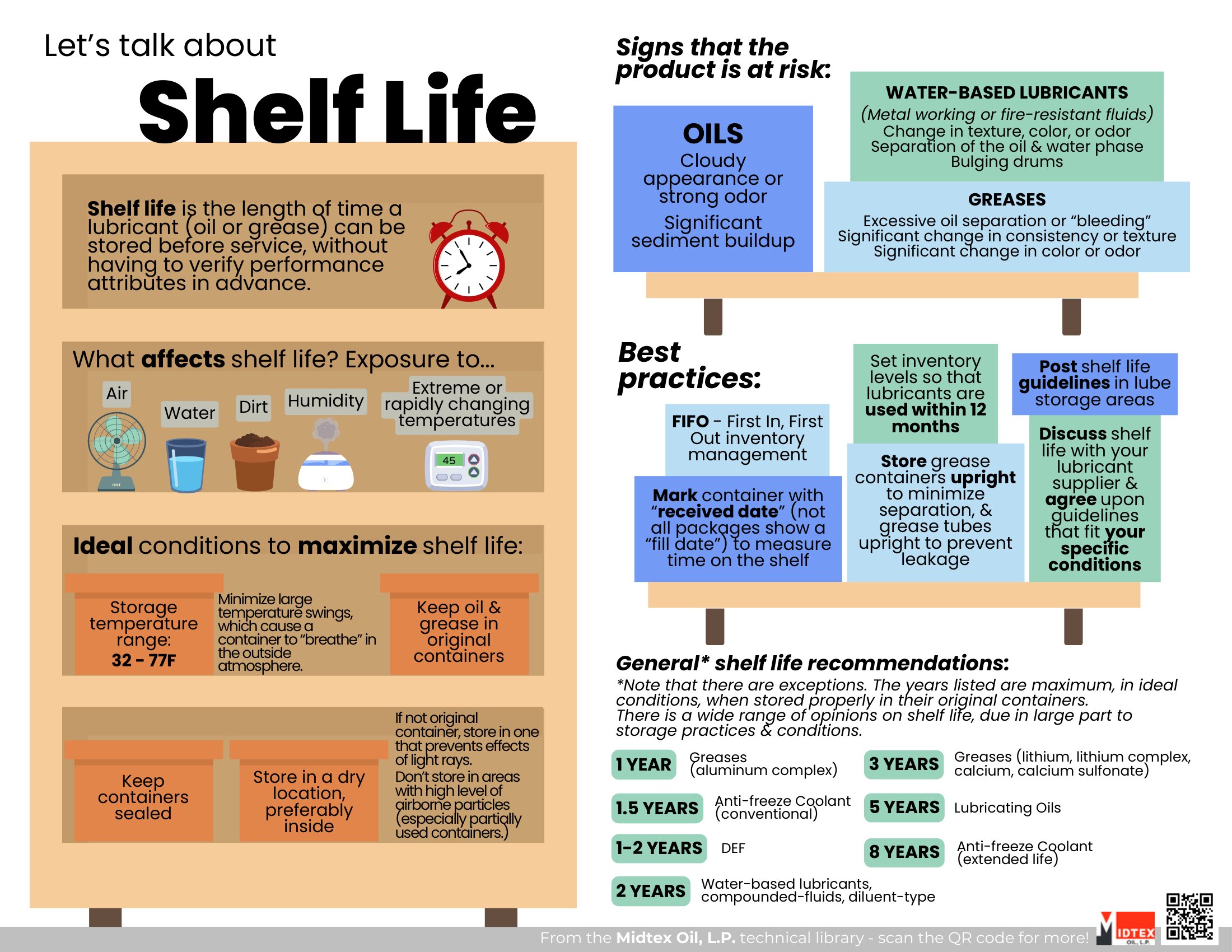
Shelf life is the length of time a lubricant (oil or grease) can be stored before service, without having to verify performance attributes in advance.
Shelf life is affected by exposure to air, water, dirt, humidity, and extreme or rapidly changing temperatures.
Ideal Conditions to Maximize Shelf Life Include:
- A storage temperature range of 32 – 77 degrees Fahrenheit (with large temperature swings minimized to the best of your ability, as these cause the container to “breathe” in the outside atmosphere)
- Being kept in their original containers (or in a container that prevents effects of light rays!)
- Keeping the containers sealed
- Storing in a dry location (preferably inside)
- Not storing in areas with high levels of airborne particles (especially for partially used containers)
Signs the Product is at Risk Include…
OILS: Cloudy appearance or strong odor. Significant sediment buildup.
WATER-BASED LUBRICANTS: (Metal-working or fire-resistant fluids) Change in texture, color, or odor. Separation of the oil and water phase. Bulging drums.
GREASES: Excessive oil separation or “bleeding”. Significant change in consistency or texture. Significant change in color or odor.
Best Practices for Maximizing Shelf Life:
- FIFO: First In, First Out inventory management
- Mark containers with “received date” (not all packages show a “fill date”) to measure time on the shelf
- Set inventory levels so that lubricants are used within 12 months
- Store grease containers upright to minimize separation, and store grease tubes upright to prevent leakage
- Post shelf life guidelines in lube storage areas
- Discuss shelf life with your lubricant supplier and agree upon guidelines that fit your specific conditions
General* Shelf Life Recommendations:
*Note that there are exceptions! The years listed are maximum, in ideal conditions, when stored properly in their original containers.
There is a wide range of opinions on shelf life, due in large part to storage practices and conditions…
- Greases (aluminum complex) – 1 year
- Anti-freeze Coolant (conventional) – 1.5 years
- DEF – 1-2 years
- Water-based Lubricants, Compounded-Fluids, Diluent-Type – 2 years
- Greases (Lithium, Lithium Complex, Calcium, Calcium Sulfonate) – 3 years
- Lubricating Oils – 5 years
- Anti-freeze Coolant (extended life) – 8 years