

Antifreeze Coolant Conversion
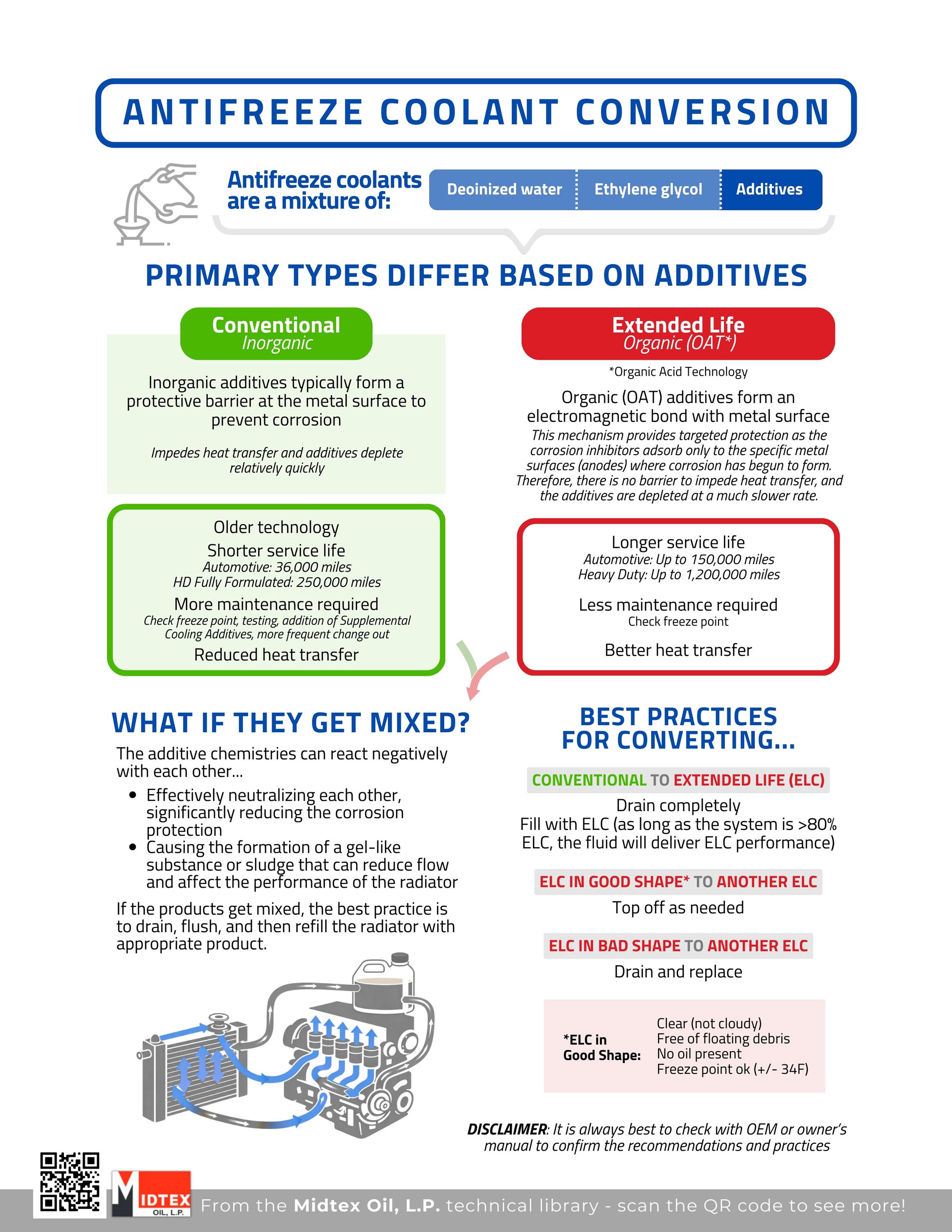
Antifreeze/coolants are mixtures of deionized water, ethylene glycol, and additives. The primary types differ based on their additive chemistry.
Conventional Coolant (Inorganic)
Inorganic additives typically form a protective barrier on metal surfaces to prevent corrosion. This barrier can impede heat transfer, and the additives deplete relatively quickly.
- Older technology
- Shorter service life
- Automotive: 36,000 miles
- Heavy-duty, fully formulated: 250,000 miles
- More maintenance required
- Check the freeze point
- Test the coolant
- Add supplemental coolant additives
- Change the coolant more frequently
- Reduced heat transfer
Extended Life Coolant (Organic Acid Technology)
Organic acid technology (OAT) additives form an electromagnetic bond with metal surfaces. This mechanism provides targeted protection because the corrosion inhibitors adsorb only to the specific metal surfaces, or anodes, where corrosion has begun to form. Therefore, there is no barrier to impede heat transfer, and the additives deplete at a much slower rate.
- Longer service life
- Automotive: Up to 150,000 miles
- Heavy-duty: Up to 1,200,000 miles
- Less maintenance required
- Check the freeze point
- Better heat transfer
What Happens If They Get Mixed?
The additive chemistries can react negatively with each other, potentially:
- Neutralizing each other and significantly reducing corrosion protection
- Forming a gel-like substance or sludge that can reduce flow and affect radiator performance
If the products get mixed, the best practice is to drain and flush the cooling system, then refill it with the appropriate product.
Best Practices for Converting Coolants
Conventional Coolant to Extended Life Coolant (ELC)
- Drain the conventional coolant completely.
- Fill the system with ELC. As long as the system contains more than 80% ELC, the fluid will deliver ELC performance.
ELC in Good Condition to Another ELC
- Top off with the appropriate ELC as needed.
What Constitutes an ELC in Good Condition?
- Clear, not cloudy
- Free of floating debris
- No oil present
- Freeze point is acceptable, with -34°F recommended
ELC in Bad Condition to Another ELC
- Drain and replace the coolant.
Disclaimer: It is always best to check with the original equipment manufacturer (OEM) or consult the owner’s manual to confirm the recommended products and conversion practices.