

Gas to Liquids (GTL)
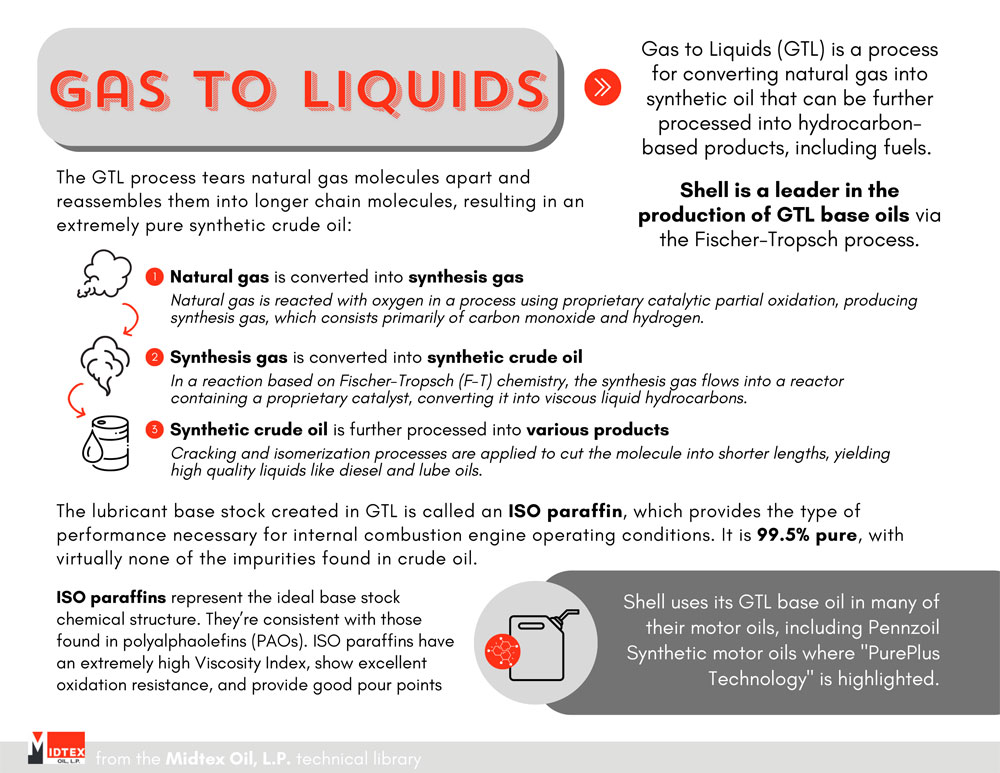
Gas to Liquids (GTL) is a process for converting natural gas into synthetic oil that can be further processed into hydrocarbon-based products, including fuels. Shell is a leader in the production of GTL base oils via the Fischer-Tropsch process!
The GTL process tears natural gas molecules apart and reassembles them into longer chain molecules, resulting in an extremely pure synthetic crude oil:
- Natural gas is converted into a synthesis gas. Natural gas is reacted with oxygen in a process using proprietary catalytic partial oxidation, producing synthesis gas, which consists primarily of carbon monoxide and hydrogen.
- Synthesis gas is converted into synthetic crude oil. In a reaction based on Fischer-Tropsch (F-T) chemistry, the synthesis gas flows into a reactor containing a proprietary catalyst, converting it into viscous liquid hydrocarbons.
- Synthetic crude oil is further processed into various products. Cracking and isomerization processes are applied to cut the molecule into shorter lengths, yielding high quality liquids like diesel and lube oils.
The lubricant base stock created in GTL is called ISO paraffin, which provides the type of performance necessary for internal combustion engine operating conditions. It is 99.5% pure, with virtually none of the impurities found in crude oil.
ISO paraffins represent the ideal base stock chemical structure. They’re consistent with those found in polyalphaolefins (PAOs). ISO paraffins have an extremely high Viscosity Index, show excellent oxidation resistance, and provide good pour points.
Shell uses its GTL base oil in many of their motor oils, including Pennzoil Synthetic motor oils where “PurePlus Technology” is highlighted.