

Let’s Chat About Oil Reservoirs
What does a reservoir accomplish?
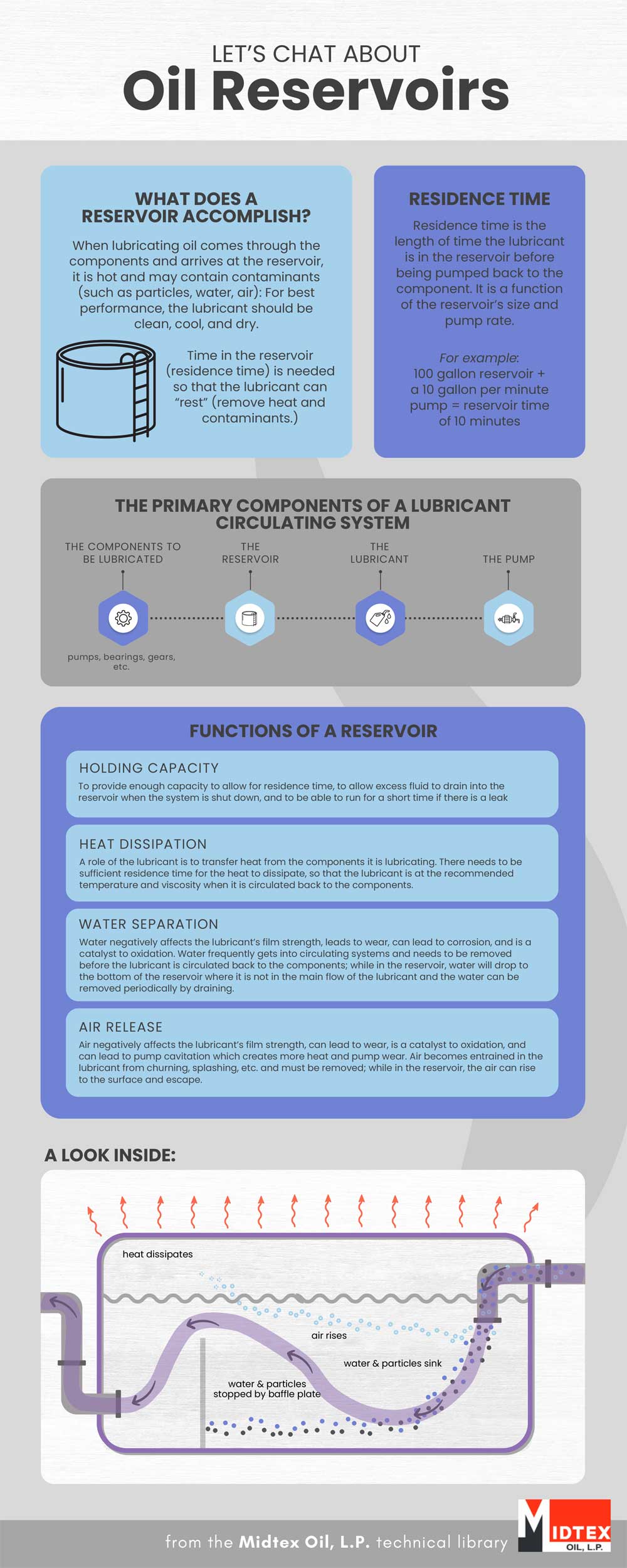
When lubricating oil comes through the components and arrives at the reservoir, it is hot and may contain contaminants (such as particles, water, air): For best performance, the lubricant should be cool, clean, and dry. Time in the reservoir (residence time) is needed so that the lubricant can “rest” (remove heat and contaminants.)
Residence Time
Residence time is the length of time the lubricant is in the reservoir before being pumped back into the component. It is a function of the reservoir’s size and pump rate.
For example: 100 gallon reservoir + a 10 gallon per minute pump = reservoir time of 10 minutes
Primary Components of a Lubricant Circulating System
- The components to be lubricated (pumps, bearings, gears, etc.)
- The reservoir
- The lubricant
- The pump
Functions of a Reservoir
Holding Capacity
To provide enough capacity to allow for residence time, to allow excess fluid to drain into the reservoir when the system is shut down, and to be able to run for a short time if there is a leak.
Heat Dissipation
A role of the lubricant is to transfer heat from the components it is lubricating. There needs to be sufficient residence time for the heat to dissipate, so that the lubricant is at the recommended temperature and viscosity when it is circulated back to the components.
Water Separation
Water negatively affects the lubricant’s film strength, leads to wear, can lead to corrosion, and is a catalyst to oxidation. Water frequently gets into circulating systems and needs to be removed before the lubricant is circulated back to the components; while in the reservoir, water will drop to the bottom of the reservoir where it is not in the main flow of the lubricant and the water can be removed periodically by draining.
Air Release
Air negatively affects the lubricant’s film strength, can lead to wear, is a catalyst to oxidation, and can lead to pump cavitation which creates more heat and pump wear. Air becomes entrained in the lubricant from churning, splashing, etc. and must be removed; while in the reservoir, the air can rise to the surface and escape.