

Food Grade Lubricants
What are food grade lubricants?
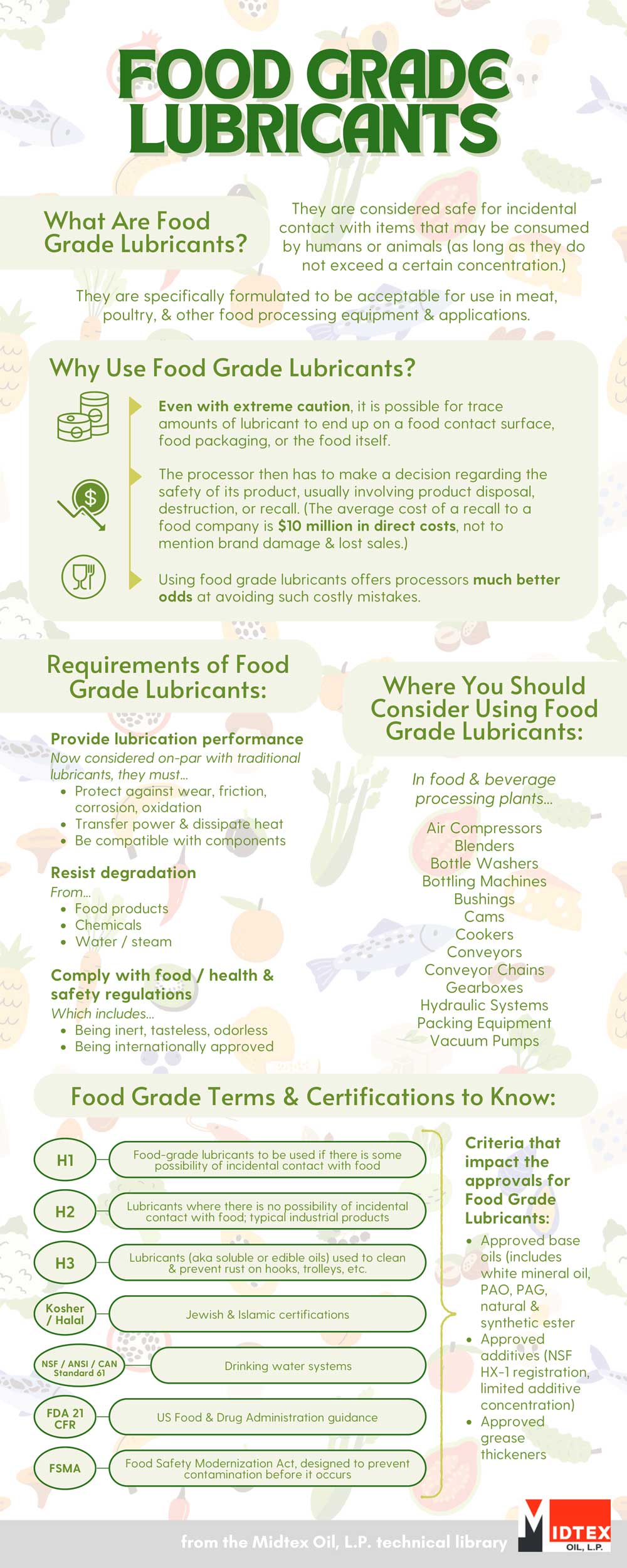
They are considered safe for incidental contact with items that may be consumed by humans or animals (as long as they do not exceed a certain concentration.) They are specifically formulated to be acceptable for use in meat, poultry, and other food processing equipment and applications.
Why use food grade lubricants?
Even with extreme caution, it is possible for trace amounts of lubricant to end up on a food contact surface, food packaging, or the food itself.
The processor then has to make a decision regarding the safety of its product, usually involving product disposal, destruction, or recall. (The average cost of a recall to a food company is $10 million in direct costs, not to mention brand damage and lost sales.)
Using food grade lubricants offers processors much better odds at avoiding such costly mistakes.
Requirements of food grade lubricants:
- Provide lubrication performance
Now considered on-par with traditional lubricants, they must…
- Protect against wear, friction, corrosion, oxidation
- Transfer power & dissipate heat
- Be compatible with components
- Resist degradation
From…
- Food products
- Chemicals
- Water/steam
- Comply with food/health and safety regulations
Which includes…
- Being inert, tasteless, odorless
- Being internationally approved
Where you should consider using food grade lubricants:
In food and beverage processing plants…
- Air compressors
- Blenders
- Bottle washers
- Bottling machines
- Bushings
- Cams
- Cookers
- Conveyors
- Conveyor chains
- Gearboxes
- Hydraulic systems
- Packing equipment
- Vacuum pumps
Food grade terms and certifications to know:
H1 – Food-grade lubricants to be used if there is some possibility of incidental contact with food
H2 – Lubricants where there is no possibility of incidental contact with food; typical industrial products
H3 – Lubricants (aka soluble or edible oils) used to clean and prevent rust on hooks, trolleys, etc.
Kosher / Halal – Jewish & Islamic certifications
NSF / ANSI / CAN / Standard 61 – Drinking water systems
FDA 21 CFR – US Food and Drug Administration guidance\
FSMA – Food Safety Modernization Act, designed to prevent contamination before it occurs
Criteria that impact the approvals for food grade lubricants:
- Approved base oils (includes white mineral oil, PAO, PAG, natural and synthetic ester
- Approved additives (NSF HX-1 registration, limited additive concentration)
- Approved grease thickeners