

Antifreeze/Coolant Maintenance
Why should you check your antifreeze/coolant?
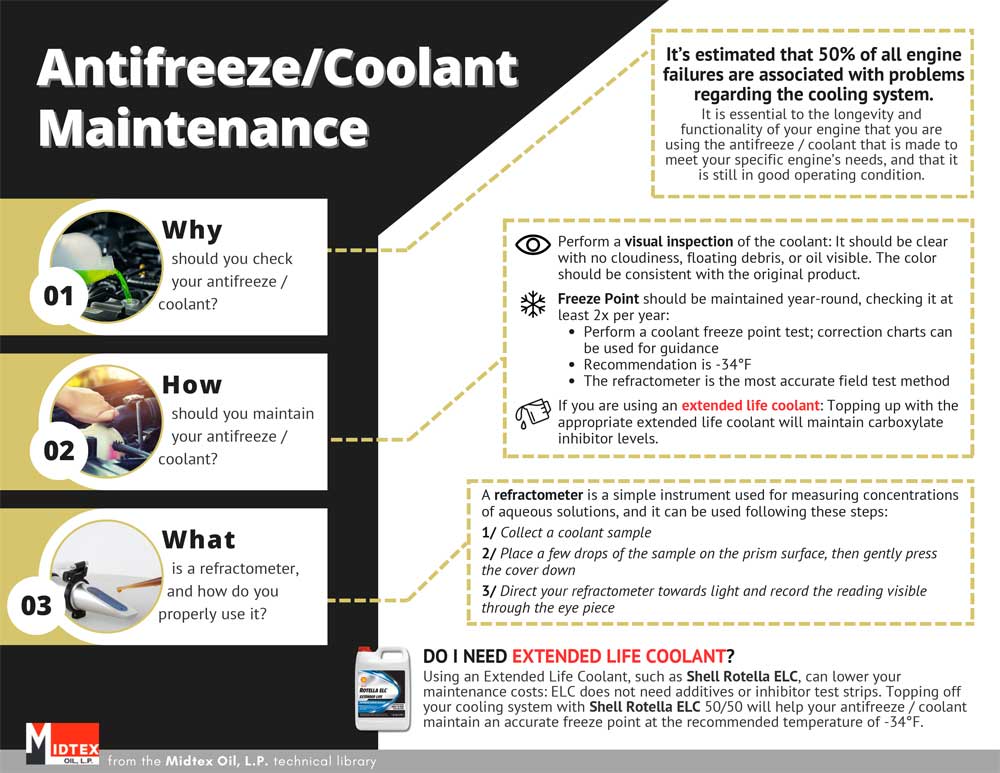
It’s estimated that 50% of all engine failures are associated with problems regarding the cooling system. It is essential to the longevity and functionality of your engine that you are using the antifreeze/coolant that is made to meet your specific engine’s needs, and that it is still in good operating condition.
How should you maintain your antifreeze/coolant?
- Perform a visual inspection of the coolant: It should be clear with no cloudiness, floating debris, or oil visible. The color should be consistent with the original product.
- Freeze point should be maintained year-round, checking it at least 2 times per year:
- Perform a coolant freeze point test; correction charts can be used for guidance
- Recommendation is -34 degrees Fahrenheit
- The refractometer is the most accurate field test method
- If you are using an extended life coolant: Topping up with the appropriate extended life coolant will maintain carboxylate inhibitor levels
What is a refractometer, and how do you properly use it?
A refractometer is a simple instrument used for measuring concentrations of aqueous solutions, and it can be used following these steps:
- Collect a coolant sample
- Place a few drops of the sample on the prism surface, then gently press the cover down
- Direct your refractometer towards light and record the reading visible through the eye piece
Do I need Extended Life Coolant?
Using an Extended Life Coolant, such as Shell Rotella ELC, can lower your maintenance costs: ELC does not need additives or inhibitor test strips. Topping off your cooling system with Shell Rotella ELC 50/50 will help your antifreeze/coolant maintain an accurate freeze point at the recommended temperature of -34 degrees Fahrenheit