

Environmentally Acceptable Lubricants (EALs)
What Qualifies & Where to Use Them
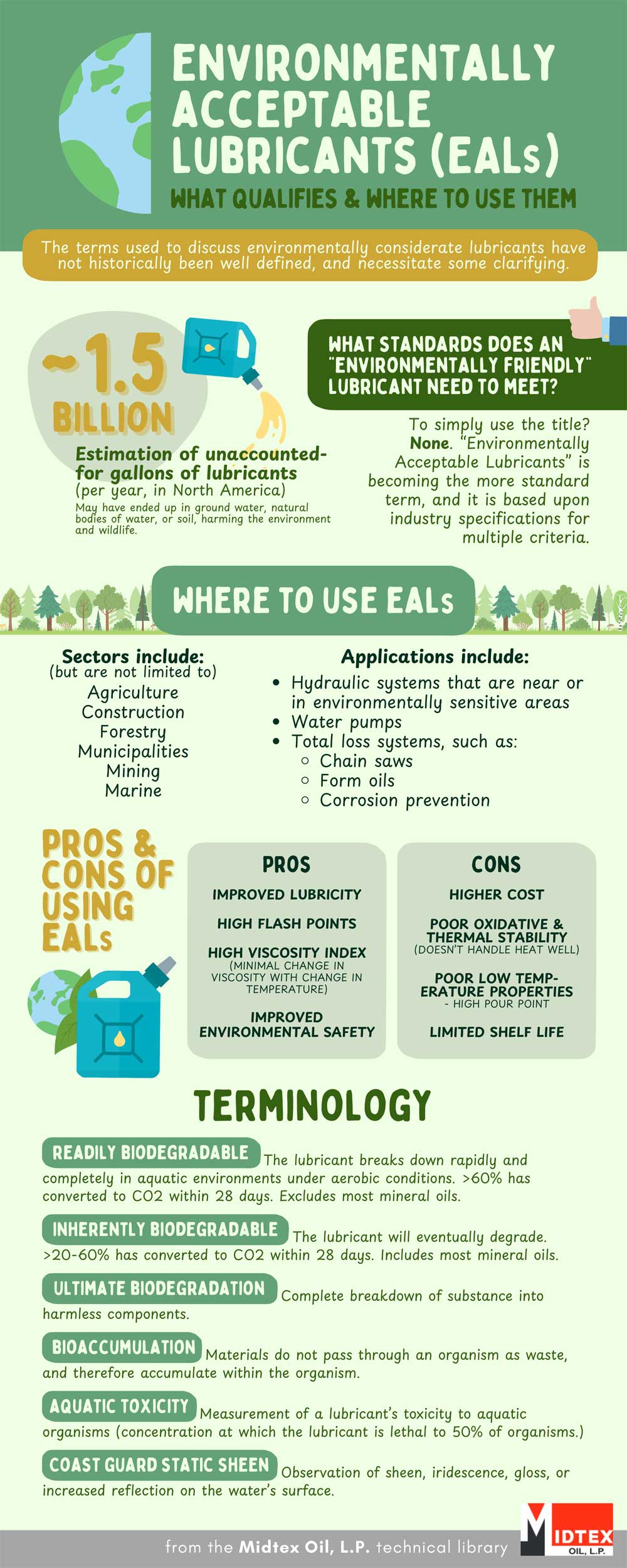
The terms used to discuss environmentally considerate lubricants have not historically been well defined, and necessitate some clarifying.
What standards does an “environmentally friendly” lubricant need to meet?
To simply use the title? None. “Environmentally Acceptable Lubricants” is becoming the more standard term, and it is based upon industry specifications for multiple criteria.
There are approximately 1.5 billion gallons of lubricants that are unaccounted for, per year, in North America. They may have ended up in ground water, natural bodies of water, or soil, harming the environment and wildlife.
Where to use EALs:
Sectors include, but are not limited to:
- Agriculture
- Construction
- Forestry
- Municipalities
- Mining
- Marine
Applications include:
- Hydraulic systems that are near or in environmentally sensitive areas
- Water pumps
- Total loss systems, such as:
- Chain saws
- Form oils
- Corrosion prevention
Pros & Cons of Using EALs
Pros:
- Improved lubricity
- High flash points
- High viscosity index (minimal change in viscosity with change in temperature)
- Improved environmental safety
Cons:
- Higher cost
- Poor oxidative & thermal stability (doesn’t handle heat well)
- Poor low temperature properties (high pour point)
- Limited shelf life
Terminology
Readily Biodegradable: The lubricant breaks down rapidly and completely in aquatic environments under aerobic conditions. >60% has converted to CO2 within 28. Excludes most mineral oils.
Inherently Biodegradable: The lubricant will eventually degrade. >20-60% has converted to CO2 within 28 days. Includes most mineral oils.
Ultimate Biodegradation: Complete breakdown of substance into harmless components.
Bioaccumulation: Materials do not pass through an organism as waste, and therefore accumulate within the organism.
Aquatic Toxicity: Measurement of a lubricant’s toxicity to aquatic organisms (concentration at which the lubricant is lethal to 50% of organisms.)
Coast Guard Static Sheen: Observation of sheen, iridescence, gloss, or increased reflection on the water’s surface.