

Diesel Fuels – A Primer
Widespread & Vital
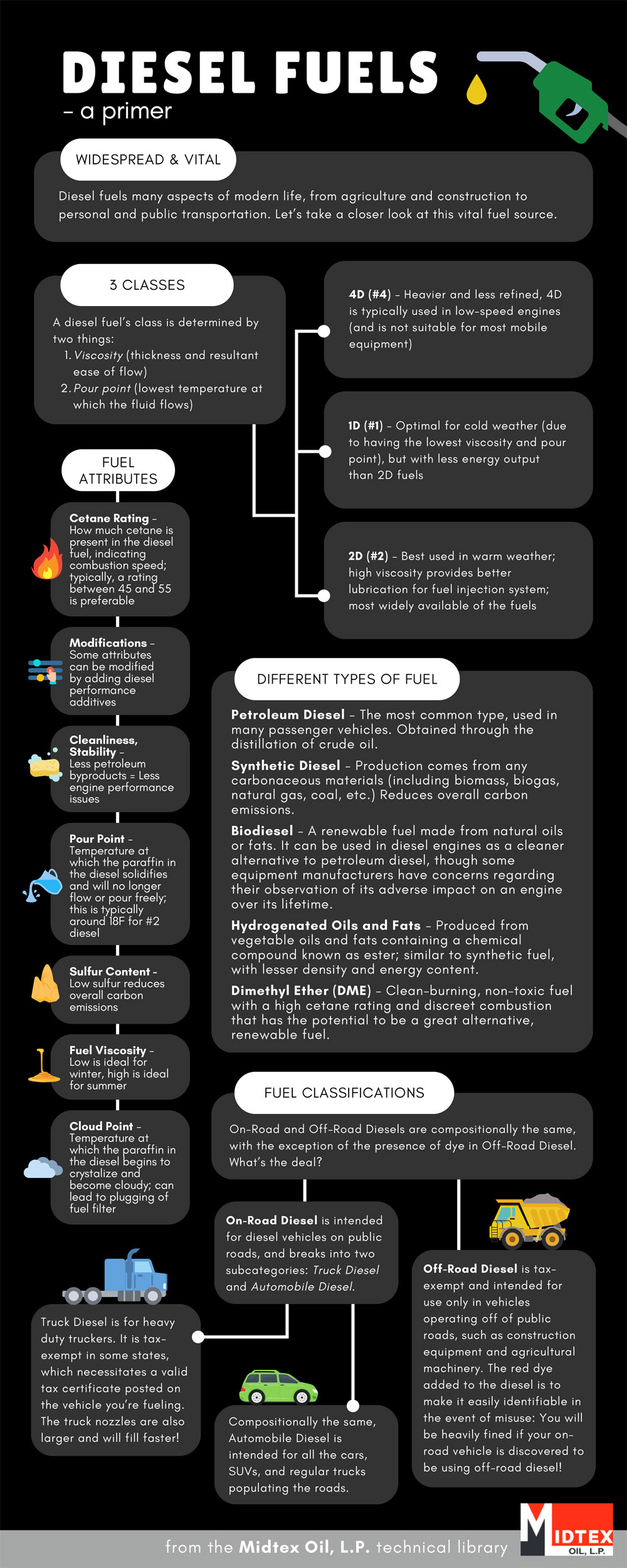
Diesel fuels many aspects of modern life, from agriculture and construction to personal and public transportation. Let’s take a closer look at this vital fuel source…
3 Classes
A diesel fuel’s class is determined by two things:
- Viscosity (thickness and resultant ease of flow)
- Pour point (lowest temperature at which the fluid flows)
The variations in these two create 3 classes of identification:
- 4D (#4) – Heavier and less refined, 4D is typically used in low-speed engines (and is not suitable for most mobile equipment)
- 1D (#1) – Optimal for cold weather (due to having the lowest viscosity and pour point), but with less energy output than 2D fuels.
- 2D (#2) – Best used in warm weather; high viscosity provides better lubrication for fuel injection systems; most widely available of the fuels.
Fuel Attributes
- Cetane Rating – How much cetane is present in the diesel fuel, indicating combustion speed; typically, a rating between 45 & 55 is preferable.
- Modifications – Some attributes can be modified by adding diesel performance additives.
- Cleanliness, Stability – Less petroleum byproducts = Less engine performance issues.
- Pour Point – Temperature at which the paraffin in the diesel solidifies and will no longer flow or pour freely; this is typically around 18F for #2 diesel.
- Sulfur Content – Low sulfur reduces overall carbon emissions.
- Fuel Viscosity – Low is ideal for winter, high is ideal for summer.
- Cloud Point – Temperature at which the paraffin in the diesel begins to crystallize and become cloudy; can lead to plugging of fuel filter.
Different Types of Fuel
- Petroleum Diesel – The most common type, used in many passenger vehicles. Obtained through the distillation of crude oil.
- Synthetic Diesel – Production comes from any carbonaceous materials (including biomass, biogas, natural gas, coal, etc.) Reduces overall carbon emissions.
- Biodiesel – A renewable fuel made from natural oils or fats. It can be used in diesel engines as a cleaner alternative to petroleum diesel, though some equipment manufacturers have concerns regarding their observation of its adverse impact on an engine over its lifetime.
- Hydrogenated Oils and Fats – Produced from vegetable oils and fats containing a chemical compound known as ester; similar to synthetic fuel, with lesser density and energy content.
- Dimethyl Ester (DME) – Clean-burning, non-toxic fuel with a high cetane rating and discreet combustion that has the potential to be a great alternative, renewable fuel.
Fuel Classifications
On-Road and Off-Road Diesels are compositionally the same, with the exception of the presence of dye in Off-Road Diesel. What’s the deal?
- On-Road Diesel is intended for diesel vehicles on public roads, and breaks into two subcategories: Truck Diesel and Automobile Diesel.
- Truck Diesel is for heavy duty truckers. It is tax-exempt in some states, which necessitates a valid tax certificate posted on the vehicle you’re fueling. The truck nozzles are also larger and will fill faster!
- Automobile Diesel is intended for all the cars, SUVs, and regular trucks populating the roads, and is compositionally the same.
- Off-Road Diesel is tax-exempt and intended for use only in vehicles operating off of public roads, such as construction equipment and agricultural machinery. The red dye added to the diesel is to make it easily identifiable in the event of misuse: You will be heavily fined if your on-road vehicle is discovered to be using off-road diesel!