

Switching Greases
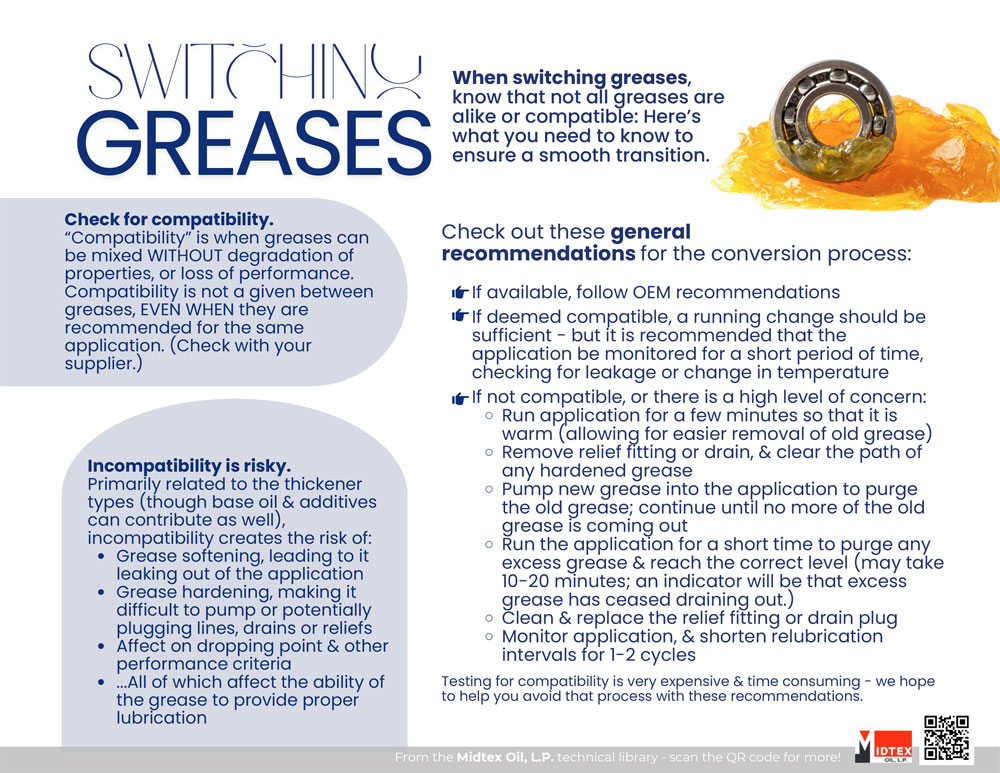
Not all greases are alike or compatible, and testing for compatibility is very expensive and time consuming. We hope to help you avoid that process with the following recommendations.
Check for Compatibility
“Compatibility” is when greases can be mixed WITHOUT degradation of properties, or loss of performance. Compatibility is not a given between greases, EVEN WHEN they are recommended for the same application. (Check with your supplier.)
Incompatibility is Risky
Primarily related to the thickener types (though base oil and additives can contribute as well), incompatibility creates the risk of:
- Grease softening, leading to it leaking out of the application
- Grease hardening, making it difficult to pump or potentially plugging lines, drains, or reliefs
- Affect on dropping point and other performance criteria
- …All of which affect the ability of the grease to provide proper lubrication
General Recommendations
Check out these general recommendations for the conversion process:
- If available, follow OEM recommendations
- If deemed compatible, a running change should be sufficient – but it is recommended that the application be monitored for a short period of time, checking for leakage or change in temperature
- If not compatible, or there is a high level of concern:
- Run application for a few minutes so that it is warm (allowing for easier removal of old grease)
- Remove relief fitting or drain, and clear the path of any hardened grease
- Pump new grease into the application to purge the old grease; continue until no more of the old grease is coming out
- Run the application for a short time to purge any excess grease and reach the correct level (may take 10-20 minutes; an indicator will be that excess grease has ceased draining out)
- Clean and replace the relief fitting or drain plug
- Monitor application, and shorten relubrication intervals for 1-2 cycles