

Contamination Control
A Quick Look at Contaminants
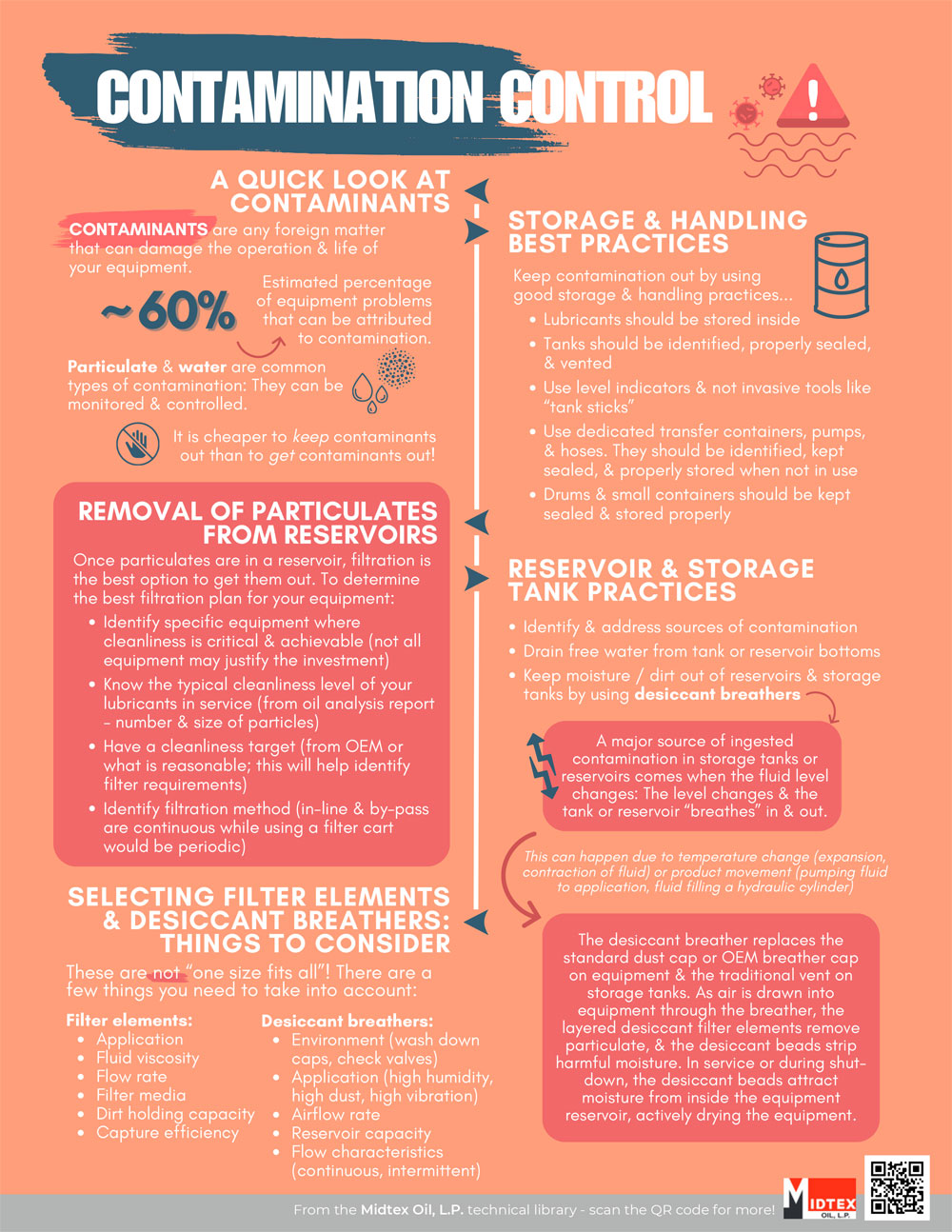
Contaminants are any foreign matter that can damage the operation and life of your equipment. Particulate and water are common times of contamination, which can be monitored and controlled.
It is estimated that approximately 60% of equipment problems can be attributed to contamination, and it is cheaper to keep contaminants out than it is to get contaminants out – so let’s zoom in on what measures can be taken to keep contaminants out in the first place!
Storage and Handling Best Practices
Keep contamination out by using good storage and handling practices…
- Lubricants should be stored inside
- Tanks should be identified, properly sealed, and vented
- Use level indicators and not invasive tools like “tank sticks”
- Use dedicated transfer containers, pumps, and hoses. They should be identified, kepy sealed, and properly stored when not in use
- Drums and small containers should be kept sealed and stored properly
Removal of Particulates from Reservoirs
Once particulates are in a reservoir, filtration is the best option to get them out. To determine the best filtration plan for your equipment:
- Identify specific equipment where cleanliness is critical and achievable (not all equipment may justify the investment)
- Know the typical cleanliness level of your lubricants in service (from oil analysis report – number and size of particles)
- Have a cleanliness target (from OEM or what is reasonable; this will help identify filter requirements)
- Identify filtration method (in-line and by-pass are continuous, while using a filter cart would be periodic)
Reservoir and Storage Tank Practices
- Identify and address sources of contamination
- Drain free water from tank or reservoir bottoms
- Keep moisture / dirt out of reservoirs and storage tanks by using desiccant breathers
- A major source of ingested contamination in storage tanks or reservoirs comes when the fluid level changes: The level changes and the tank or reservoir “breathes” in and out.
- This can happen due to temperature change (expansion, contraction of fluid) or product movement (pumping fluid to application, fluid filling a hydraulic cylinder)
- The desiccant breather replaces the standard dust cap or OEM breather cap on equipment and the traditional vent on storage tanks. As air is drawn into equipment through the breather, the layered desiccant filter elements remove particulate, and the desiccant beads strip harmful moisture. In service or during shut-down, the desiccant beads attract moisture from inside the equipment reservoir, actively drying the equipment.
Selecting Filter Elements and Desiccant Breathers: Things to Consider
These are NOT “one size fits all”! There are a few things you need to take into account…
Filter Elements:
- Application
- Fluid viscosity
- Flow rate
- Filter media
- Dirt holding capacity
- Capture efficiency
Desiccant Breathers:
- Environment (wash down caps, check valves)
- Application (high humidity, high dust, high vibration)
- Airflow rate
- Reservoir capacity
- Flow characteristics (continuous, intermittent)