

Air as a Contaminant
What are Contaminants?
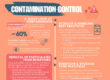
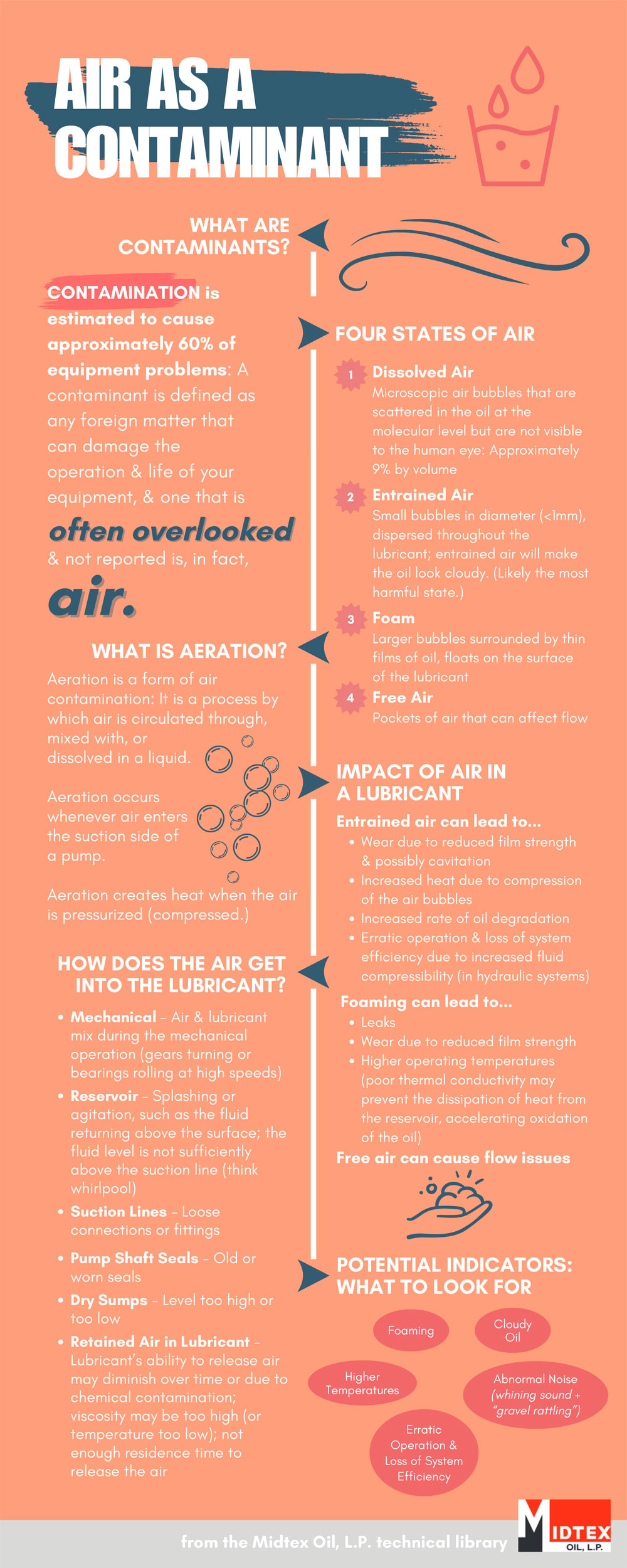
Contamination is estimated to cause approximately 60% of equipment problems, so defining what exactly a contaminant is is important business! A contaminant is defined as any foreign matter that can damage the operation and life of your equipment. One that is often overlooked and not reported is air.
Four States of Air
Dissolved Air
Microscopic air bubbles that are scattered in the oil at the molecular level but are not visible to the human eye: Approximately 9% by volume.
Entrained Air
Small bubbles in diameter (<1mm), dispersed throughout the lubricant; entrained air will make the oil look cloudy. (Likely the most harmful state.)
Foam
Larger bubbles surrounded by thin films of oil, floats on the surface of the lubricant.
Free Air
Pockets of air that can affect flow.
What is Aeration?
Aeration is a form of contamination: It is a process by which air is circulated through, mixed with, or dissolved in a liquid. Aeration occurs whenever air enters the suction side of a pump. Aeration creates heat when the air is pressurized (compressed.)
Impact of Air in a Lubricant
Entrained air can lead to…
- Wear due to reduced film strength and possibly cavitation
- Increased heat due to compression of the air bubbles
- Increased rate of oil degradation
- Erration operation and loss of system efficiency due to increased fluid compressibility (in hydraulic systems)
Foaming can lead to…
- Leaks
- Wear due to reduced film strength
- Higher operating temperatures (poor thermal conductivity may prevent the dissipation of heat from the reservoir, accelerating oxidation of the oil)
Free air…
- Free air can cause flow issues
How Does the Air Get in the Lubricant?
- Mechanical: Air and lubricant mix during the mechanical operation (gears turning or bearings rolling at high speeds)
- Reservoir: Splashing or agitation, such as the fluid returning above the surface; the fluid level is not sufficiently above the suction line (think whirlpool)
- Suction Lines: Loose connections or fittings
- Pump Shaft Seals: Old or worn seals
- Dry Sumps: Level too high or too low
- Retained Air in Lubricant: Lubricant’s ability to release air may diminish over time or due to chemical contamination; viscosity may be too high (or temperature too low); not enough residence time to release the air
Potential Indicators: What to Look Out For
- Foaming
- Cloudy oil
- Higher temperatures
- Abnormal noise (whining sound + “gravel rattling”)
- Erratic operation and loss of system efficiency